What to Wear to a Bangkok Elephant Sanctuary (And What to Pack)
What to wear to an elephant sanctuary in Thailand comes down to one rule: bring clothes you are willing to ruin, because every full-day tour on this site ends in a mud-bathing session. I have watched first-timers show up in white linen and spend the afternoon regretting it, so this guide walks through exactly what the sanctuaries provide, what is genuinely worth packing, and what to leave folded at the hotel. It covers footwear, the fabric choices that actually hold up, a season-by-season breakdown with real Bangkok temperatures, and the extra gear the Erawan waterfall add-on demands. Pack light. Most of what a first-time packing list assumes you need is already covered by the tour itself.
Quick answer
Wear old clothes you don't mind staining and pack a full change of clothes for after the mud bath. Every full-day sanctuary on this site provides lunch, transport, and entry; you provide the layers, the footwear, and a plan for mud.
Key takeaways
- Every tour includes a mud-bathing session, so old clothes and a spare change are non-negotiable
- Rinseable sandals or old trainers with grip beat flip-flops on wet forest and riverbank ground
- Sunscreen and insect repellent go on before you arrive, never sprayed at the sanctuary
- Cool season, November through February, runs 21 to 32°C; hot season peaks near 37°C in April
- The Erawan waterfall add-on needs swimwear, water shoes and reef-safe sunscreen bought on site
- Flash photography and strong perfume are banned close to the elephants at every sanctuary
What to Wear
Every one of our full-day elephant sanctuary experiences builds the same mud session into the day, so the outfit advice below applies no matter which tour you book.
Base Layer: Old Clothes You Can Ruin
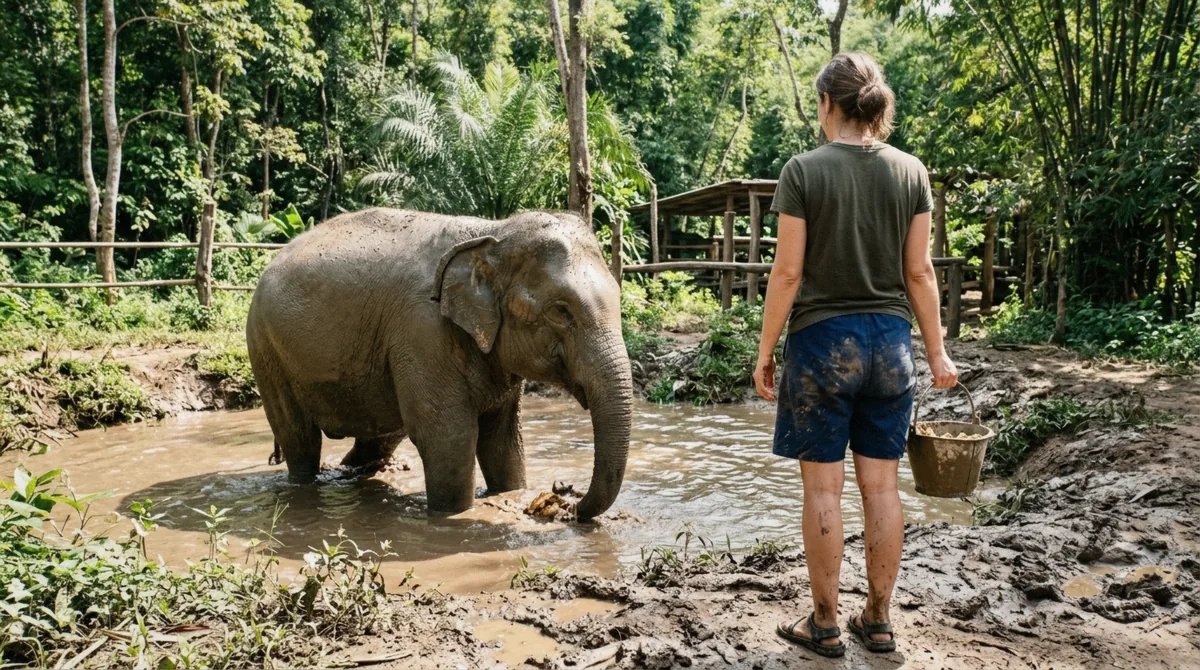
Every full-day tour here builds in a mud-bathing session with the elephants, and mud stains light colours fast, so dark, well-worn clothing is the practical choice, guidance that comes straight from Bangkok Elephant Park's own staff. Think of the outfit as disposable rather than photogenic: a cotton t-shirt and shorts or light trousers you already own, nothing new, nothing you would mind if it never came fully clean again. Quick-dry synthetic fabric holds up better across a long day than heavy cotton, but the honest requirement is simpler than fabric science: wear something old, because it will stain, and pack a full change of clothes for the ride home.
Footwear
The operators are consistent on this point: rinseable sandals or old trainers with grip are the right footwear, not flip-flops. Forest paths at Living Green and Bangkok Elephant Park are uneven, riverbank ground at ElephantsWorld gets slick after the mud session, and an unsecured sandal is a genuine way to lose a shoe in ankle-deep mud. Closed-toe old trainers work well if you don't mind sacrificing a pair; secured sandals with a back strap and real tread work just as well and dry faster afterward.
Heels and unsecured flip-flops are the two choices every tour flags as impractical, not because of a strict rule but because the terrain punishes them within the first hour.
Sun Layer: Hat and Sunscreen Applied Early
A wide-brimmed hat and a long-sleeve layer for the early pickup do more work than sunscreen alone, since Bangkok's sun is strong enough by mid-morning to burn exposed skin fast. The one rule every sanctuary enforces is timing: sunscreen and insect repellent must go on before arrival, never sprayed once you're near the elephants, since the scent and aerosol can spook them. Apply both at the hotel before your 06:30 or 07:00 pickup, not in the parking lot once the van has already stopped.
What to Bring
Beyond the clothes on your back, this short list covers what actually earns its space in a day bag. Traveling with children? Our elephant sanctuary bangkok with kids guide has age-specific packing notes.
- Full change of clothes: the mud bath is not optional on a full-day tour
- Rinseable sandals or old trainers: grip matters more than style
- Small dry bag: protects your phone during feeding and mud sessions
- Cash in Thai baht: mahout tips and park fees are paid on site
- Reusable water bottle: a long day in full sun adds up fast
- Hat with a chin strap: it loses in an open-air pickup truck otherwise
- Sunscreen and repellent, applied before arrival, never sprayed near the elephants
- Camera with flash disabled: flash photography is banned at every sanctuary
- Light rain layer during June through October: tours run rain or shine
- Swimwear and a towel, only if your tour includes the Erawan waterfall add-on
What the Tours Provide So You Don't Overpack
Read-out: every tour on this site includes round-trip transport and full-day sanctuary entry; lunch is standard on the longer itineraries, and the Kanchanaburi and Erawan combinations each add one extra item worth planning around.
| Item | Usually Provided | Bring Your Own | Notes |
|---|---|---|---|
| Round-trip transport | Yes, every tour | - | Hotel pickup included on the Bangkok Elephant Sanctuary tour |
| Sanctuary entry fee | Yes, every tour | - | Bundled into the tour price |
| Lunch | Yes, on full-day tours | Snacks for the drive | Traditional Thai lunch included on the Bangkok Elephant Park tour |
| Mahout guide | Yes, every tour | - | Supervises every feeding and mud-bathing session |
| Towel for the mud bath | No | Bring your own or plan to air dry | Pack a spare towel if you'd rather not ride home damp |
| Change of clothes | No | Bring a full spare set | Every tour ends in mud |
| Water shoes for Erawan | No | Bring your own with grip | Needed only on the Erawan waterfall combo |
| Swimwear | No | Bring your own | Only relevant for the Erawan add-on |
| Reef-safe sunscreen for the Erawan pools | Sold at the park | Buy on site or bring your own reef-safe brand | Regular sunscreen is banned in the pools |
| Smart-casual layer for the war cemetery | No | Bring one modest outfit | Required on the ElephantsWorld and Kanchanaburi combo |
| Insect repellent | No | Bring your own, apply before arrival | Spraying at the sanctuary itself is not allowed |
| Bottled water | Varies by tour | A refillable bottle is worth carrying anyway | Confirm inclusions at booking |
What NOT to Wear or Bring
A short list sourced straight from the operators' own restrictions, not generic packing-blog advice:
- Flash photography setups: banned at all six sanctuaries, it startles the herd
- Strong perfume or scented sunscreen: banned close to the elephants at every stop
- Insect repellent sprayed on site: apply it before arrival instead
- Outside food for the elephants: feeding only happens in the supervised session
- Alcohol in the tour vehicle: flagged specifically on the Kanchanaburi combo
- Unsecured flip-flops: the terrain will take them from you within the first hour
- New or precious clothing: the mud bath does not negotiate
The Erawan combo adds two of its own restrictions: regular sunscreen is not allowed in the waterfall pools, and leaving the marked trail at Erawan National Park isn't permitted either. Both exist for the same reason as the elephant-side rules: protecting a shared natural space, not slowing you down for its own sake. None of these restrictions are announced with much fanfare on the booking page, so guests who skip the pre-departure email are the ones most often caught out with a bag full of the wrong gear at the gate.
Packing by Season in Thailand
Cool Season: November to February
Cool season is the most comfortable stretch to visit, with temperatures running 21 to 32°C across the day. Mornings at a 06:30 pickup are genuinely cool enough to want a light long-sleeve layer, which you'll shed by mid-morning once the sun clears the treeline. This is the easiest season to dress for: one extra layer, otherwise the same mud-ready outfit as any other month.
Hot Season: March to May
Hot season peaks in April, when Bangkok routinely climbs toward 37°C by early afternoon. Skip the extra layer entirely and prioritize the lightest, most breathable fabric you own, along with more water than you think you'll need. The mud bath actually helps here; it's the one part of the day that genuinely cools you down.
Rainy Season: June to October
September is the wettest month, but the tours run rain or shine, and a mud pit does not care whether the rain started it or you did. Quick-dry fabric and a proper dry bag for your phone matter more in this window than any other; pack a light poncho or rain shell rather than an umbrella, since your hands will be full with feeding baskets most of the morning.
Broken down by season rather than by month, the same packing logic looks like this:
| Season | Wear This |
|---|---|
| November-February, cool, 21-32°C | A light long-sleeve layer for the 06:30 pickup, otherwise your standard mud-ready outfit |
| March-May, hot, up to 37°C in April | The lightest breathable fabric you own, plus extra water |
| June-October, rainy, September wettest | Quick-dry synthetic clothing, a dry bag for your phone, and a light rain shell |
However the year breaks down, the mud-ready basics stay constant: old dark clothing, rinseable footwear, and a full change of clothes. If the season itself is what's making you hesitate on booking at all, our honest look at whether the day trip pays off walks through how each month changes the day.
The Erawan Waterfall Add-On
If your tour includes the Erawan waterfall combo, pack swimwear, a towel, water shoes with real grip, and a waterproof bag for your phone or camera. Regular sunscreen is banned in the waterfall pools since it damages the ecosystem; reef-safe sunscreen is sold at the park, or bring your own reef-safe brand from home. Erawan National Park charges its own entry fee on site: 300 THB for an adult, 150 THB for a child, paid in cash, so keep baht on hand separate from any mahout tip money.
At roughly 33.4 THB to the US dollar as of July 2026, that works out to about $9 for an adult and $4.50 for a child, on top of the tour price. The park's entry fee is charged separately in cash; our breakdown of what a sanctuary day actually costs covers the exact Erawan fees so they don't catch you at the gate.
The ElephantsWorld and Kanchanaburi combo is a different kind of long day: 126 km each way in the van, roughly 2 to 2.5 hours, so dress for comfort in air-conditioning as much as for the sanctuary itself. Small cash also goes further than a card here: a generous mahout tip runs 100 to 200 THB, and drinks at roadside stops are cash-only.
Frequently Asked Questions
Can I wear shorts to an elephant sanctuary?
Yes, on the sanctuary portion of any tour; quick-dry shorts are fine and dry faster than trousers after the mud bath. The one exception is the Kanchanaburi combo's war cemetery stop, where a smart-casual, more modest layer is expected.
Will the mud ruin my shoes?
It will stain them, which is exactly why rinseable sandals or old trainers are the standard recommendation rather than anything new. Bring a pair you've already accepted won't come back looking the same.
Is there somewhere to change after the mud bath?
Yes, every sanctuary has a basic changing area or restroom near the mud-bathing pool. It's simple rather than private, so pack your change of clothes somewhere easy to reach in your bag.
Do I need water shoes if my tour doesn't include Erawan?
No. Rinseable sandals or old trainers cover every sanctuary-only tour. Water shoes with real grip only become necessary on the Erawan waterfall combo, where wet rock underfoot is a different kind of terrain.
Can I bring my phone into the mud pit?
Only in a dry bag, and most guests leave it with a bag on the sidelines during the mud session itself rather than risk it. A small waterproof pouch is worth the few dollars if you want mud-bath photos.
Can I wear jeans on the sanctuary tour?
You can, but they're a poor choice: jeans stay wet and heavy for hours once mud-soaked and restrict movement during feeding and bathing sessions. Quick-dry shorts or light trousers work far better.
What should I NOT bring at all?
Skip anything you'd be upset to stain or lose: jewelry, new clothing, and unsecured sandals top the list, alongside spray-on sunscreen or repellent, which isn't allowed once you're near the elephants.
Does it matter what color I wear near the elephants?
Not for the animals' sake, but practically, dark and mid-tone clothing hides mud stains far better than white or pastel colors. There's no operator rule about color, just an honest heads-up from anyone who has worn light grey to a mud bath and regretted it by lunchtime.